

Vial Filling and Capping Machine: Working, Applications & Buying Guide
Table of Contents
- Introduction
Key Takeaways
- Discover the vital role of vial filling and capping in pharmaceutical packaging processes.
- Understand key automation features to enhance the efficiency of vial filling and capping operations.
- Learn about the various configurations and production rates of vial cap sealing machines.
- Explore the importance of integrating filling and capping stages in the complete packaging line.
- Choose Lodha International LLP for reliable solutions as a Vial Filling and Capping Machine Manufacturer in India.
Vial filling and capping are closely connected stages in pharmaceutical packaging. After the product is filled and the vial is stoppered, the cap-sealing stage must handle the container carefully and apply the closure consistently.
At Lodha International LLP, we provide vial filling, stoppering and cap-sealing solutions for pharmaceutical, veterinary, biotechnology and related applications. As a Vial Filling and Capping Machine Manufacturer in India, we focus on matching the equipment with the vial size, cap format, production requirement and required level of automation.
What Is a Vial Filling and Capping System?
A vial filling and capping system combines multiple packaging stages required to prepare filled and securely closed vials.
Depending on the project, filling and capping can be performed on separate machines connected through conveyors or incorporated into an integrated vial-processing line. Lodha's vial filling line information describes stoppered vials moving from the filling stage to the cap-sealing machine for aluminium or flip-off cap application.
The vial cap sealing machine is therefore an important downstream part of the complete filling and packaging process.
How Does Vial Cap Sealing Work?
The exact process varies according to the machine configuration, but automatic vial cap sealing generally follows these stages:
- Vial Infeed: Filled and stoppered vials enter the capping machine and are positioned through the infeed arrangement.
- Cap Feeding: Caps are supplied automatically and moved toward the sealing station.
- Cap Positioning: The cap is positioned correctly over the vial.
- Cap Sealing: Spring-loaded sealing rollers secure the cap while supporting smooth and controlled crimping.
- Process Monitoring: The system monitors vial movement and counts processed containers.
- Discharge: Sealed vials move toward inspection, Labeling or another downstream packaging stage.
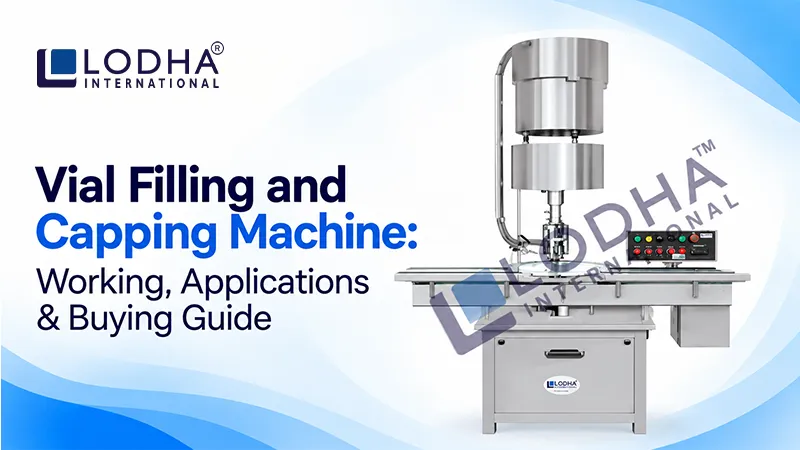
Lodha's vial cap sealing system uses synchronized conveyor, star-wheel and turret movement with variable-frequency speed control. Safety clutch mechanisms are incorporated to help protect vials during operation.
LI-VCS Vial Cap Sealing Configurations
Different sealing-head configurations allow the machine to be selected according to production requirements.
| Model | Sealing Heads | Production Rate | Vial Height |
|---|---|---|---|
| LI-VCS 1 | Single | Max. 50 vials/min | 25–150 mm |
| LI-VCS 4 | 4 | Up to 120 vials/min | 25–150 mm |
| LI-VCS 8 | 8 | 120–240 vials/min | 25–200 mm |
| LI-VCS 10 | 10 | According to final machine configuration | According to final configuration |
| LI-VCS 12 | 12 | According to final machine configuration | According to final configuration |
| LI-VCS 16 | 16 | According to final machine configuration | According to final configuration |
The published LI-VCS 1, LI-VCS 4 and LI-VCS 8 specifications also support cap diameters of 13, 20, 25 and 28 mm with suitable change parts.
For higher-head LI-VCS configurations, output should be finalized according to vial dimensions, cap size, machine layout and approved project specification rather than estimated from head count alone.
Automation, Safety and Process-Control Features
When selecting equipment from a Vial Filling and Capping Machine Manufacturer in India, automation should be evaluated together with container handling and safety.
Depending on the selected machine configuration, relevant features may include:
- PLC with graphical user interface
- No Vial–No Capping functionality
- No Cap–No Capping on applicable high-speed configurations
- Automatic cap feeding
- Variable-frequency speed control
- Integrated vial counting
- Safety and overload clutch mechanisms
- Automatic machines stop if a container overturns.
- Clutch protection to help reduce vial breakage.
- Quick adjustment and change parts for different cap sizes
- Easy-to-dismantle components for cleaning.
- Integration with filling, inspection and Labeling equipment
Lodha's high-speed vial capping system specifically describes No Vial–No Capping and No Cap–No Capping controls, along with synchronized VFD-driven operation and an inbuilt pulse counter.
21 CFR Part 11 and Pharmaceutical Automation
For pharmaceutical projects requiring enhanced electronic control, 21 CFR Part 11-compliant software for the HMI/PLC is available on applicable vial cap-sealing configurations. This functionality should be finalized according to the approved automation and validation requirements of the project.
Where an IPC with SCADA system is required, it should be specified according to the selected pharmaceutical machine and approved automation scope rather than treated as a standard feature on every configuration.
For pharmaceutical applications, suitable machine configurations can also be designed to support EU GMP and US FDA cGMP requirements, depending on the supplied features and final scope of supply.
Hygienic and Maintenance-Focused Design
Pharmaceutical vial processing requires equipment that can be operated and cleaned practically.
Relevant design features include stainless-steel construction, accessible machine areas, dismantlable cap-feeding components and sealing arrangements designed to minimize unnecessary damage to caps and vials.
The sealing mechanism uses spring-loaded rollers, while the hopper arrangement can be dismantled for cleaning. Safety and overload clutches are also used on the infeed and discharge arrangements.
Applications
Vial filling and capping systems are particularly relevant for:
- Pharmaceutical injectable products
- Veterinary products
- Biotechnology applications
- Sterile vial-processing lines
- Vaccine and biologics packaging where suitable.
- R&D and pharmaceutical development applications
Lodha positions its automatic vial cap sealing equipment particularly for pharmaceutical, veterinary and biotechnology applications.
Why Filling and Capping Line Integration Matters
Once a vial is filled and stoppered, controlled transfer to the capping stage helps maintain a smooth production workflow.
Lodha's vial filling-line configuration connects the filling stage with flip-off or aluminium cap sealing, while the broader packaging portfolio allows capping equipment to form part of an integrated automated line.
A properly planned line can coordinate:
Filling → Stoppering → Cap Sealing → Inspection → Labeling → Packing
This is why equipment selection should consider the complete packaging process rather than treating the capper as an isolated machine.
Why Choose Lodha International LLP?
At Lodha International LLP, we provide vial filling and cap-sealing equipment for different production requirements, from lower-output applications to multi-head high-speed systems.
Our vial cap-sealing solutions incorporate automated cap feeding, controlled vial handling, safety mechanisms, PLC-based controls and integration with pharmaceutical packaging lines. Higher-head configurations can also be selected according to project requirements.
As a Vial Filling and Capping Machine Manufacturer in India, we work with customers to evaluate the vial, closure, required output, automation and complete packaging process before finalizing the system.
Conclusion
Choosing the right vial filling and capping system requires more than selecting the machine with the highest number of sealing heads. Vial dimensions, cap format, production output, automation, safety functions and integration with filling and downstream packaging equipment all need to be considered.
At Lodha International LLP, vial filling and cap-sealing solutions can be configured according to the production requirement, from standard LI-VCS systems to higher-head configurations for increased output.
If you are looking for a Vial Filling and Capping Machine Manufacturer in India, contact Lodha International LLP to discuss your vial size, cap format, required production output and automation requirements.
Phone: +91 74350 31331
Email: info@lodhapharma.com
Frequently Asked Questions
A vial filling and capping machine is an integrated system used in pharmaceutical packaging to fill and securely cap vials. This machine handles the filling of the product into vials and applies the closure consistently, ensuring the vials are prepared for further downstream processing.
Choosing the right vial filling and capping machine involves evaluating several factors, including vial dimensions, cap format, required production output, and the level of automation needed. It's crucial to consider how the equipment will integrate with the entire packaging process to ensure smooth operation.
Automated vial capping systems provide increased efficiency, accuracy, and safety in the packaging process. They minimize human intervention, reduce the risk of errors, and often include safety mechanisms to protect the vials during operation.
Lodha International LLP, as a Vial Filling and Capping Machine Manufacturer in India, works closely with customers to tailor solutions based on specific requirements. This includes considering factors such as vial size, production rates, automation needs, and integration with existing packaging lines.
Vial filling and capping machines are particularly relevant for pharmaceutical products, veterinary applications, biotechnology processes, and sterile packaging lines. They are essential in the packaging of injectables, vaccines, and biologics, ensuring products are securely capped and ready for distribution.


