

How to Select an Automatic Vial Cap Sealing Machine for Pharmaceutical Packaging
Table of Contents
- Introduction
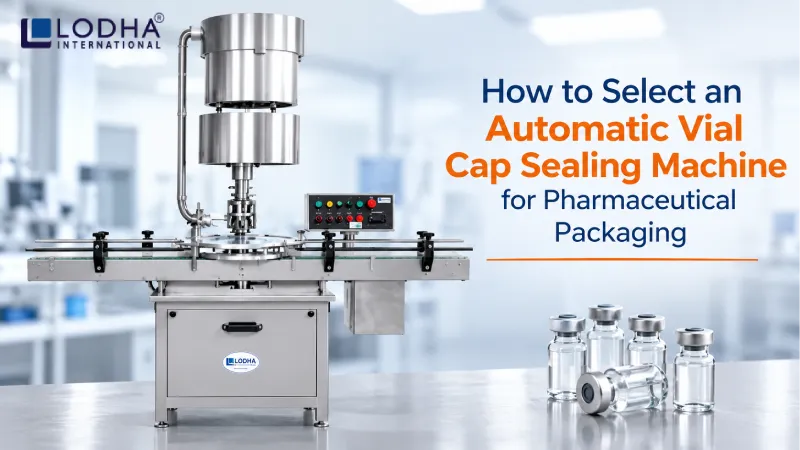
Key Takeaways
- Confirm vial and cap dimensions as the first step in selecting an automatic vial cap sealing machine.
- Compare different configurations based on production speed and vial specifications before choosing a machine.
- Lodha International LLP is a trusted automatic vial cap sealing machine manufacturer in India offering tailored solutions.
- Evaluate reliable vial handling controls to minimize breakage and ensure smooth packaging operations.
- Examine sealing head mechanisms for consistent performance and prevent cap damage during sealing.
Lodha International LLP is a leading manufacturer of automatic vial cap sealing machines.
Selecting the right vial cap sealing system is critical when pharmaceutical packaging lines handle injectable glass vials and flip-off caps. The machine must match the vial dimensions, cap size, required output and line configuration. As an Automatic Vial Cap Sealing Machine Manufacturer in India, we focus on these application details before recommending the right model for production.
Start With Vial Size and Cap Compatibility
The first step is to confirm the exact vial and cap dimensions. Different sealing machines are designed to handle a defined range of vial diameters, vial heights and cap sizes.
The LI-VCS range is designed for vial diameters from approximately 24 mm to 90 mm, depending on the model. Cap sizes of 13 mm, 20 mm, 25 mm and 28 mm can be handled with suitable change parts.
The correct machine should be selected around the actual vial and closure combination, not output alone.
Compare the Available LI-VCS Configurations
Production requirement is one of the main differences between the available automatic vial cap sealing configurations.
| Model | Sealing Heads | Listed Output | Vial Height |
|---|---|---|---|
| LI-VCS 1 | Single Head | Max. 50 vials/min | 25–150 mm |
| LI-VCS 4 | Four Head | Up to 120 vials/min | 25–150 mm |
| LI-VCS 8 | Eight Head | 120–240 vials/min | 25–200 mm |
The LI-VCS 1 is suited to lower-output production requirements, while LI-VCS 4 supports medium-scale production. For higher production requirements, LI-VCS 8 provides multiple sealing heads with a higher listed output range.
As an Automatic Vial Cap Sealing Machine Manufacturer in India, we recommend comparing output together with vial size, cap specification and the complete pharmaceutical packaging workflow.
Check How the Cap Sealing Process Works
In an automatic vial cap sealing machine, vials enter through the conveyor and are transferred by the infeed star wheel. The star wheel spaces and positions each vial before sealing.
Caps are delivered through the automatic cap-feeding system, and the vial then reaches the sealing station. A spring-loaded sealing roller applies the cap while helping reduce damage to the aluminium closure. After sealing, the vial moves toward the discharge section.
This synchronized movement is important when the machine operates as part of a larger injectable packaging line.
Look for Bottle and Vial Handling Controls
Reliable vial handling is particularly important because glass containers can be sensitive to impact or misalignment.
Relevant LI-VCS features include:
- No Vial–No Capping functionality
- Automatic cap feeding
- Clutch protection to help prevent vial breakage.
- Overload protection on infeed and discharge star wheels.
- Automatic stop if a container overturn
- Single-motor synchronization of conveyor, star wheels and platform turret
- Variable-frequency drive for speed control
- Integral pulse counting
These features support coordinated movement through the sealing process and reduce avoidable machine stoppages caused by improper vial handling.
Evaluate the Sealing Head and Cap Finish
The sealing mechanism should produce a consistent crimp without unnecessary damage to the cap.
Lodha's automatic vial cap sealing system uses specialized sealing rollers designed to form a smooth, scratch-free skirt. The spring-loaded arrangement also allows adjustment for variations in bottle-neck diameter while protecting aluminium caps during the sealing process.
For pharmaceutical buyers, this makes the sealing-head arrangement an important part of machine evaluation rather than only focusing on speed.
Review Automation Requirements
All three currently listed LI-VCS configurations include PLC with GUI in the automation specification. The conveyor, star wheels and platform turret operate through a synchronized drive system with variable-frequency speed control.
For pharmaceutical projects requiring advanced software or electronic-record functionality, the final control-system scope should be discussed during machine configuration.
Where applicable, suitable pharmaceutical machine configurations can be designed to support EU GMP and US FDA cGMP requirements, according to the controls, documentation and features supplied.
Advanced requirements such as IPC with SCADA System – 21 CFR Part 11 Compliance should only be included when they are confirmed for the selected configuration rather than treated as standard across every vial capping machine.
Consider Cleaning, Maintenance and Machine Access
Cleaning access matters in pharmaceutical packaging because machine components must be inspected and maintained regularly.
The LI-VCS machine uses stainless-steel construction around relevant areas, and the sealing roller hopper can be dismantled for cleaning. The machine is also built with access doors for servicing.
A polycarbonate-profile cabinet covering the complete machine is listed as an optional accessory for the current LI-VCS configurations.
What Should Pharmaceutical Buyers Check Before Selection?
Before approaching an Automatic Vial Cap Sealing Machine Manufacturer in India, confirm the actual packaging parameters.
- Vial diameter and height
- Cap diameter and cap type
- Required vials per minute
- Number of sealing heads
- Flip-off cap requirement
- Upstream filling or stoppering equipment
- Downstream inspection or Labeling equipment
These details make it easier to select the right sealing-head configuration and avoid choosing a machine based only on production rate.
Why Choose Us
At Lodha International LLP, we provide automatic vial cap sealing machines for pharmaceutical, biotech and related applications with single-head, four-head and eight-head configurations. Our machines include automatic cap feeding, synchronized vial handling, VFD speed control, PLC-based operation and protective mechanisms for vial movement. As an Automatic Vial Cap Sealing Machine Manufacturer in India, we focus on matching the machine to the actual vial, cap and production-line requirement rather than recommending one configuration for every application.
Conclusion
Selecting an automatic vial cap sealing machine requires more than comparing output figures. Vial dimensions, cap size, production speed, sealing-head configuration, automation and line integration all influence the right choice.
Lodha International LLP offers LI-VCS 1, LI-VCS 4 and LI-VCS 8 configurations for different production requirements. Working with an experienced Automatic Vial Cap Sealing Machine Manufacturer in India helps pharmaceutical manufacturers evaluate these parameters together and select a machine suited to the actual packaging process.
Planning a pharmaceutical vial packaging line? Contact Lodha International LLP to discuss your vial size, cap dimensions, sealing-head requirement and production target.
Phone: +91 7435031331
Email: info@lodhapharma.com
Frequently Asked Questions
Key factors include vial size, cap compatibility, required output, sealing head configuration, and integration with the pharmaceutical packaging workflow. It's crucial to match these parameters with the specific needs of the production line.
In an automatic vial cap sealing machine, vials are fed through a conveyor, spaced by an infeed star wheel, and then sealed at the sealing station. The machine uses spring-loaded sealing rollers to apply caps while ensuring minimal damage during the process.
Lodha International LLP is known for matching the sealing machines to the actual vial and cap specifications while offering configurations that cater to various production needs. Their machines are designed with features like automatic cap feeding and protection mechanisms for enhanced reliability.
Reliable vial handling is crucial because glass containers can be sensitive to impact or misalignment. Features such as 'No Vial–No Capping' functionality and overload protection help prevent damage during the sealing process.
Pharmaceutical buyers should confirm vial diameter, cap type, required output, sealing head count, flip-off cap requirements, and compatibility with upstream and downstream equipment. These details are essential for selecting the right machine configuration.


