

Automatic Screw Capping Machine: Working, Benefits & Buying Guide
Table of Contents
- Introduction
Key Takeaways
- Automatic screw capping machines streamline production with consistent cap handling and improved efficiency.
- Choosing the right automatic screw capping machine manufacturer in India can significantly impact your packaging process.
- The LI-BCS 1 enhances safety and control with features like no-bottle/no-cap operation and overload protection.
- Considering bottle dimensions and cap types is crucial when selecting an automatic screw capping machine for your needs.
- Automatic screw capping machines reduce manual labor, offering faster changeover and easier maintenance for production lines.
A reliable capping process is important for keeping bottle packaging consistent and supporting smooth movement through the production line.
At Lodha International LLP, we manufacture automatic screw capping solutions for pharmaceutical, cosmetic, food, pesticide and related packaging applications. As an Automatic Screw Capping Machine Manufacturer in India, we focus on matching the machine with the bottle, cap type, required output and packaging process.
What Is an Automatic Screw Capping Machine?
An automatic screw capping machine is designed to feed, position and tighten screw-type or compatible CRC caps onto bottles as part of an automated packaging process.
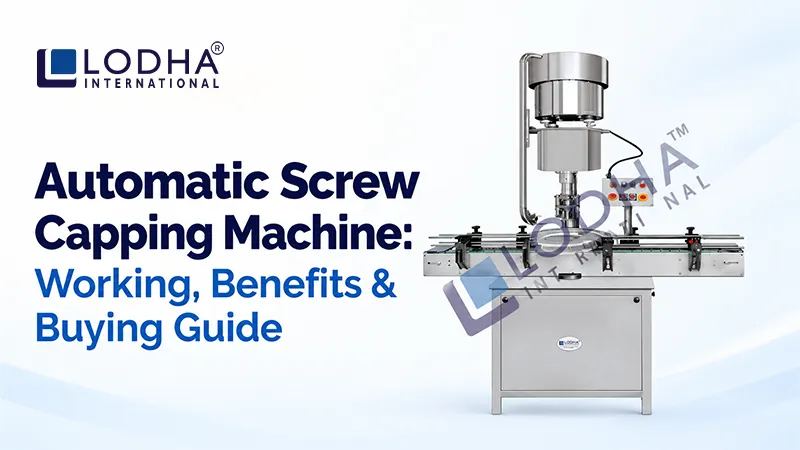
The LI-BCS 1 is an automatic single-head screw capping machine designed for medium-scale production. It combines a conveyor, infeed and outfeed star wheels, controlled cap feeding and a single capping head in one system. The machine has an adjustable-height arrangement and stainless-steel-enclosed construction.
How Does an Automatic Screw Capping Machine Work?
The capping process follows a coordinated sequence:
- Bottle Feeding: Bottles enter the machine through the conveyor.
- Bottle Positioning: The infeed star wheel guides each bottle into the capping position.
- Cap Feeding: Caps are supplied through the controlled cap-feeding system.
- Cap Placement: The capping head positions the cap on the bottle.
- Screw Tightening: The head tightens the cap to complete the closure.
- Bottle Discharge: The outfeed star wheel transfers the capped bottle toward the next packaging stage.
The LI-BCS 1 uses coordinated star-wheel and turret movement to support repeatable bottle handling during capping.
Automation, Safety and Control Features
Depending on the final machine configuration, the automatic screw capping system includes practical controls and safeguards for continuous packaging operations.
Key features include:
- No Bottle–No Cap operation
- No Cap–Machine Stop functionality.
- Controlled cap-feeder speed
- Overload clutch on the star-wheel system to help protect bottles.
- Single-motor control for coordinated star-wheel and turret operation
- Reduced setup and changeover time
- Detachable hopper for thorough cleaning
- Multiple machine safeguards
- Adjustable machine height
- Easy access for servicing and maintenance
For pharmaceutical projects requiring electronic control and record-management functions, optional 21 CFR Part 11 software compliance for the HMI/PLC is available for this machine configuration. This should be finalized according to the automation package and approved scope of supply.
This keeps the compliance statement specific to the software/control system rather than presenting the complete machine as “21 CFR certified.”
GMP-Oriented Design for Pharmaceutical Applications
For pharmaceutical production, easy cleaning, controlled operation and machine safety are important considerations.
The LI-BCS 1 incorporates stainless-steel fabrication, an enclosed machine structure, a detachable hopper and protection systems intended to support practical cleaning, maintenance and safe operation.
For pharmaceutical applications, the machine can be specified with appropriate automation and documentation according to the required project scope. Lodha also lists optional 21 CFR Part 11 HMI/PLC software and qualification documentation for this machine family.
Key Benefits of Automatic Screw Capping
A properly configured automatic capping machine can provide several practical advantages:
- Consistent bottle and cap handling
- Reduced repetitive manual cap placement.
- Controlled cap feeding
- Automatic stop when caps are unavailable.
- Protection against bottle breakage through clutch mechanisms
- Faster adjustment and changeover
- Easier cleaning and maintenance
- Integration with downstream packaging operations
These benefits make automatic screw capping suitable for manufacturers looking to organize the bottle-closing stage within a continuous production workflow.
Applications
Automatic screw capping equipment is suitable for bottle-closing applications across industries including:
- Pharmaceuticals
- Herbal and nutraceutical products
- Cosmetics
- Food and beverages
- Pesticides
- Biotech
- Dairy products
Actual suitability depends on the bottle geometry, closure type, cap dimensions and production requirement.
LI-BCS 1 Technical Specifications
The LI-BCS 1 is specified for bottles up to 85 mm in diameter and approximately 150 mm in height, with plastic screw or CRC caps up to 38 mm. The listed production speed is up to 60 bottles per minute.
Other listed specifications include:
- Model: LI-BCS 1
- Power: 1.0 HP
- Electrical: 415V AC 3-phase / 220V AC single-phase, 50 Hz, with AC drive
- Conveyor Height: 815–850 mm
- Overall Dimensions: 1500 × 735 × 1800 mm
Actual suitability and output should be confirmed against the bottle and cap being used because specifications may vary with the application.
What to Check Before Selecting the Machine
When evaluating an Automatic Screw Capping Machine Manufacturer in India, buyers should consider more than production speed.
Bottle Dimensions
Confirm bottle diameter, height, shape and base stability.
Cap Type and Size
Check whether screw or CRC caps are being used and confirm their dimensions.
Required Output
Evaluate whether a single-head configuration and output of up to 60 BPM suit the production requirement.
Changeover Requirements
Consider how often bottle or cap formats will change during production.
Safety Features
Review no-bottle/no-cap controls, machine-stop functions and overload protection.
Automation Requirements
For pharmaceutical projects, determine whether advanced HMI/PLC controls and 21 CFR Part 11 software functionality are required.
Line Integration
Consider how the capping machine will connect with filling, Labeling, inspection or packing equipment.
Why Choose Lodha International LLP?
At Lodha International LLP, we focus on application-based capping solutions.
The LI-BCS 1 combines automatic bottle movement, controlled cap feeding, single-head capping, machine-stop functions, bottle-protection mechanisms and accessible cleaning and maintenance features.
As an Automatic Screw Capping Machine Manufacturer in India, we work with manufacturers to understand the bottle, cap and production requirements before finalizing the machine configuration.
For pharmaceutical applications requiring higher automation and electronic controls, suitable software and documentation options can also be discussed according to the final project scope.
Conclusion
An automatic screw capping machine helps coordinate bottle feeding, cap handling, tightening and discharge within an automated packaging process.
The right selection depends on bottle dimensions, cap type, production output, changeover needs, safety requirements and the required level of automation.
If you are looking for an Automatic Screw Capping Machine Manufacturer in India, contact Lodha International LLP to discuss your bottle, cap and production requirements.
Phone: +91 74350 31331: Email: info@lodhapharma.com: Lodha Machines
Frequently Asked Questions
When choosing an automatic screw capping machine, consider key features such as bottle and cap dimensions, production output, safety mechanisms, and automation capabilities. Ensure the machine offers efficient bottle handling, controlled cap feeding, and easy maintenance.
An automatic screw capping machine enhances production efficiency by providing consistent bottle and cap handling, reducing manual labor, and streamlining the capping process. This leads to faster production times and minimizes the risk of errors, making it ideal for high-volume operations.
The main benefits include consistent capping quality, increased production speed, reduced manual intervention, and features to protect bottles from damage. Additionally, these machines often have quick changeover options for different bottle sizes and types.
Yes, the LI-BCS 1 is designed with GMP-oriented features, making it suitable for pharmaceutical applications. It offers stainless-steel fabrication, controlled operation, and options for compliance with regulatory standards.
To ensure the right selection, evaluate factors like bottle dimensions, cap type, required production output, and safety features. Additionally, consider potential line integration with existing packaging systems to optimize your production process.


